Whooping It Up: Pockets of Black Safety and the World We Practice
Note: This reflection sits alongside the YAIT story (podcast episode) called the World We Practice Here. If you haven’t listened yet, I recommend beginning with the story then returning here. Click here to listen.
Where have you felt safe as a Black person—safe enough to loosen your shoulders, laugh out loud, and take up space without being watched, managed, or corrected?
I’ve been thinking about those rare pockets of Black safety—the places where calm and dignity are possible, not because racism disappears, but because Black people have intentionally shaped environments where our humanity is not under threat. These spaces are not accidental. They are practiced.
That question is one of the threads behind my recent YAIT Town story, The World We Practice Here—a drama-free, conflict-free immersive story that imagines Black life without centering harm, urgency, or escalation.
That’s right! Black stories do not need to center harm, conflict, or escalation to be authentic and powerful.
This piece stands on its own, but it also grows out of that same practice: asking what becomes possible when Black safety is treated as essential, not exceptional.
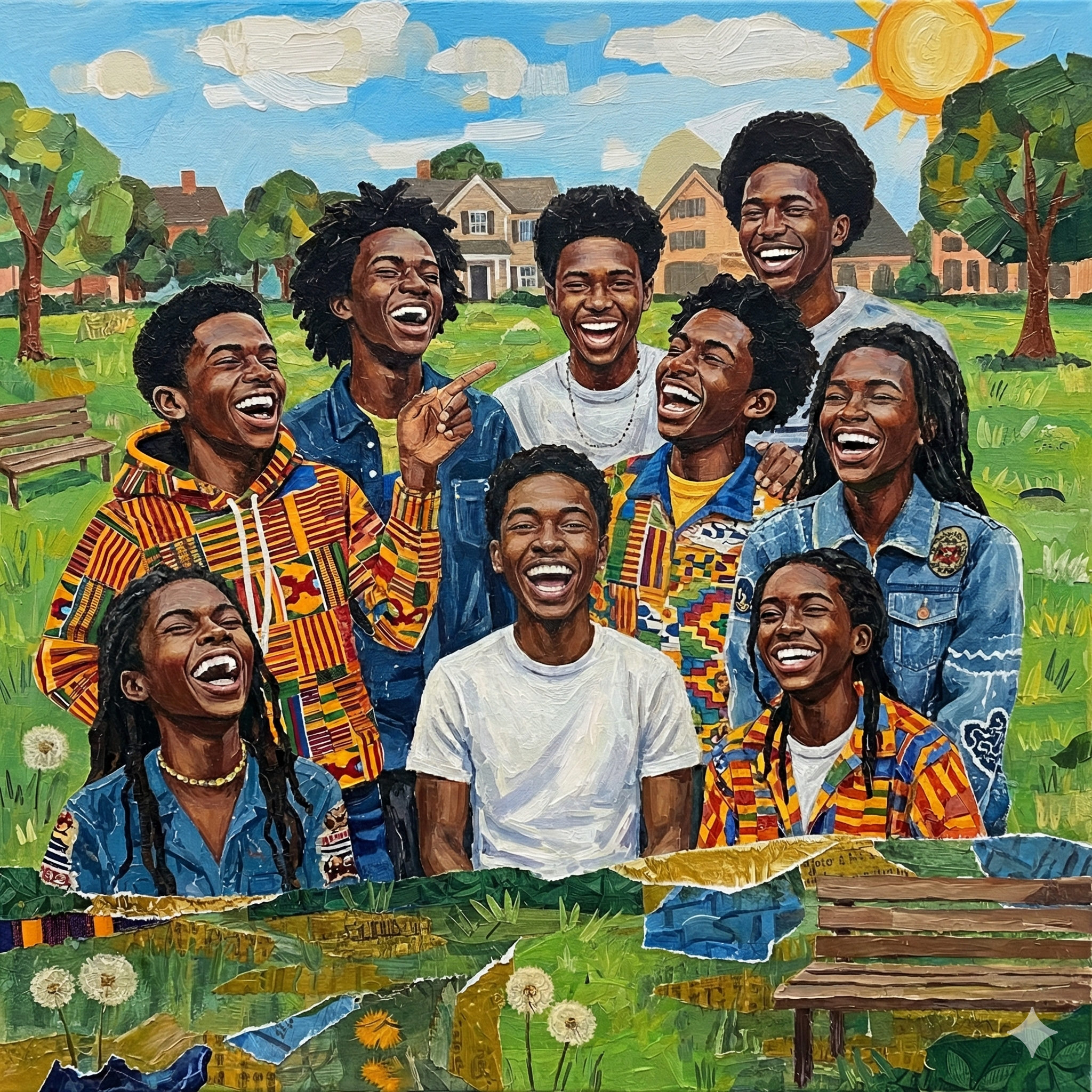
In the story, there’s a moment where a group of young people are laughing out loud. Nothing dramatic. Nothing disruptive. Just laughter — loose, full, unguarded.
Where I come from, we used to call that “whooping it up!”
It meant you were somewhere safe enough to let your joy be loud.
Safe enough not to measure your tone.
Safe enough not to scan the room for who might misunderstand you, surveil you, or decide you needed to move along.
Watching those young people in the story, I was reminded of one time I felt that kind of ease as an adult.
I felt it when I visited Morehouse College. Students laughing openly, taking up space, being exactly who they were — not performing, not defending, not shrinking.
I felt it again in a bookstore at Howard University. I sat on a couch with a book for hours.
No stares.
No white gaze.
No quiet pressure to justify my presence by buying something I didn’t want.
No kept receipt as proof of legitimacy.
No security hovering.
No tension humming under my skin.
Just me. A book. Time. A couch.
Those moments matter more than we’re taught to believe.
Because what they show us is this:
There are pockets of safety — very specific ones — where Black people can exist without hypervigilance, stress, or racial drama. Not because harm has disappeared, but because care and safety have been intentionally built.
And those spaces don’t happen by accident.
As James Baldwin reminded us, we have to create the conditions in which we can live.
We don’t stumble into freedom.
We practice it. We rehearse it.
We build it piece by piece.
That’s what those moments represent: young people laughing without being policed, readers resting without being rushed, bodies unbraced, even briefly.
This is world-building at the smallest, most human scale.
Not a perfect world. Not a permanent one. But a practiced one.
And practice matters.
Because once you’ve felt what it’s like to exist without armor — even for an hour — you don’t forget it. You start to recognize where you fit. You start to notice where you don’t. And you start to imagine what it would take to make more of those spaces real.
That’s where imagination begins. Not in fantasy — but in memory, recognition, and desire.
Piece by piece. Moment by moment. This is the world we practice.
And you ain’t imagining this!
Note: If you arrived here through this blog, please remember that the YAIT podcast episode is waiting for you. If you listened to the podcast episode, thank you for staying with this reflection!